Date Table Manners: Master Any Dinner With Style

Reading time: 11 minutes
The waiter presents the wine list, your date confidently orders a Château Margaux 2015, and suddenly an array of cutlery lies in front of you that looks like a set of surgical instruments. Especially on a first dinner date with a successful sugar daddy, how you carry yourself in the restaurant decides whether it stays a one-night affair or becomes the start of a long-term arrangement. Table manners on a date are not dusty conventions but the key to acting with confidence in fine dining.
According to a 2019 study by the University of Oxford, 89 percent of respondents judge their date on the first meeting largely by their behavior at the table. Especially in sugar dating, where dinners at Michelin-starred restaurants are the norm, a lack of dinner etiquette knowledge weighs particularly heavily. The good news: a polished presence can be learned – with the right tricks you'll come across as self-assured in any restaurant.
The cutlery choreography: working from the outside in
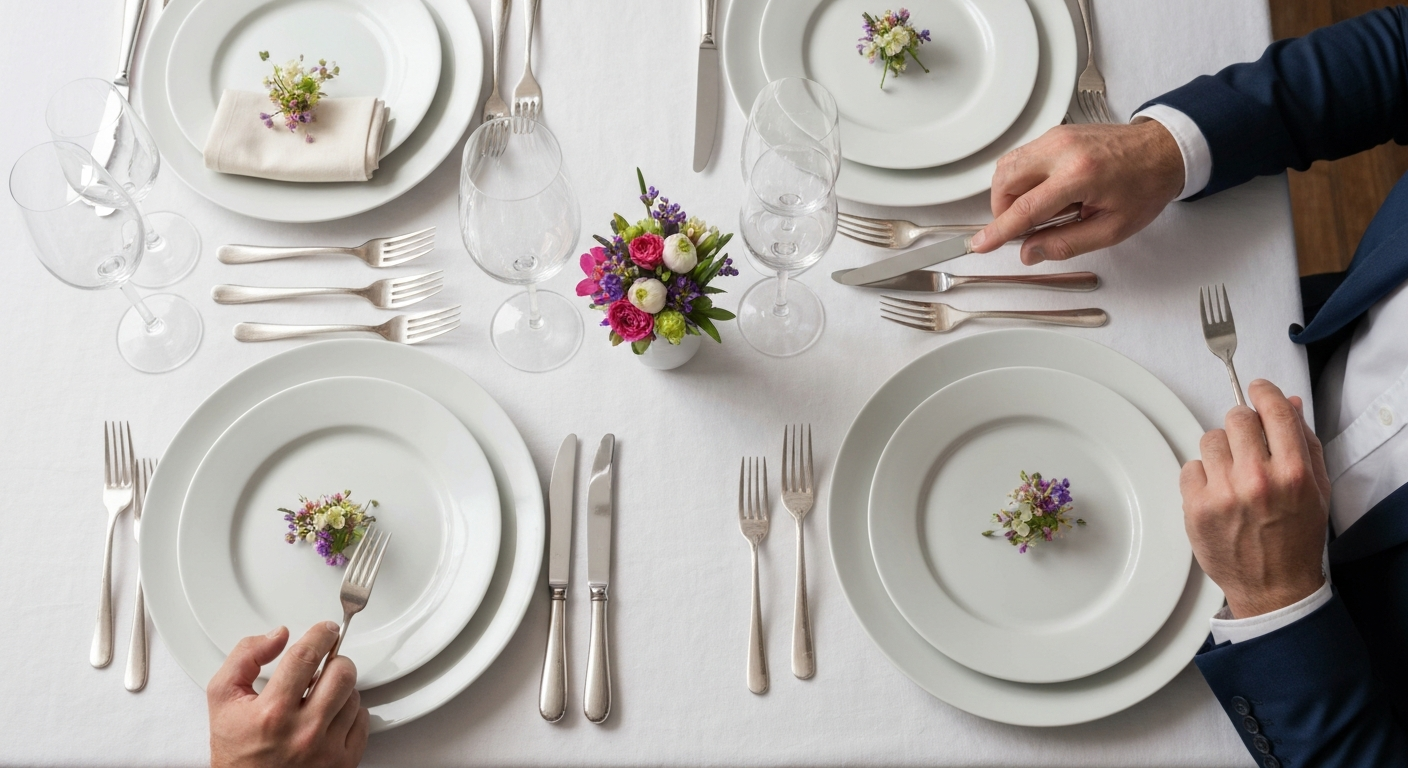
The most important principle with multi-course menus: you work from the outside in. The outermost pieces of cutlery are meant for the first course, the inner ones for the main course. This rule comes from French haute cuisine of the 19th century and still applies in upscale restaurants worldwide. At a classic five-course menu at the Berlin restaurant "Facil" or at "Tantris" in Munich, there are typically three forks to the left and three knives to the right of the plate.
You can recognize fish knives by their wide, blunt blade – they aren't for cutting but for separating fillets. The dessert cutlery either lies horizontally above the plate or is only brought out with the dessert. A common mistake: mixing up the dessert cutlery and already using it for the main course. If you're unsure, discreetly watch your date or follow the other guests. As described in gracefully avoiding conversation traps on a first meeting, attentiveness is the key to success.
Cutlery language for advanced diners
Your cutlery communicates with the waitstaff. If you place knife and fork parallel in the 4:20 position on the plate, you signal: "I'm finished." The 8:20 position means: "It tasted excellent." Crossed cutlery means: "I'm taking a break." These signals were standardized in 1889 at the Hotel Adlon in Berlin and have applied internationally ever since. According to the German Knigge Council (Knigge-Rat Deutschland), however, only 34 percent of people under 30 use this cutlery language correctly.
Choosing wine and drinking rituals: more than a matter of taste
When your date hands you the wine list, it isn't a test – but it is often a chance to show interest. You don't have to be a sommelier, but basic knowledge makes an impression. A safe tip: with fish or seafood, choose a white wine like Chablis or Grüner Veltliner, with red meat a red wine like Merlot or Tempranillo. The Robert Weil winery in Kiedrich in Germany recommends its Riesling Kabinett to pair with Asian cuisine – an unusual but knowledgeable choice.
When clinking glasses: keep eye contact and hold the glass by the stem, not the bowl. The rule "women don't clink glasses" has been outdated since the 2010s – in modern etiquette, equality is a given. However: you don't clink with water glasses, which is considered bad luck, a tradition from French seafarers. If you decline alcohol, that's perfectly acceptable – confidently order a non-alcoholic drink or water.
Understanding the wine tasting ritual
When the sommelier pours the wine for your date to taste, it isn't about whether it tastes good. It's a quality check: is the wine corked? Is it at the right temperature? Your date swirls the glass, smells briefly and takes a small sip. A nod is enough as approval. This ritual dates back to 1780 and was established at the Château de Versailles to identify spoiled wines.
Posture and table presence: your nonverbal business card
Your posture says more about you than a thousand words. Sit upright, but not stiff – your back doesn't rest against the chair back, your forearms rest loosely on the table. Your hands stay visible, but elbows don't belong on the table – this rule dates back to medieval times, when wobbly tables could tip over. According to a 2021 study by the University of Chicago, 76 percent of men see an upright posture as a sign of confidence and interest.
Your smartphone stays in your bag or at least on silent and face down on the table. A 2022 survey by the dating portal ElitePartner found that 92 percent of respondents find phone use on a date disrespectful. Exception: you're expecting an important call and tell your date beforehand. This transparency creates understanding and also shows your priorities. Much like handling money conversations with confidence, it's about open communication.
Napkin etiquette: the underrated art
The cloth napkin goes folded on your lap as soon as everyone at the table is seated – not before. It's used only to dab your lips, not to wipe your hands and certainly not to blow your nose. If you leave the table briefly, place the napkin loosely on the chair, not on the plate. At the end of the meal you place it to the left of the plate – never fold it neatly, as that wrongly signals to the staff that the napkin is clean and reusable.
At the French Michelin-starred restaurant "Le Bernardin" in New York, the staff refold the napkin when a guest goes to the restroom – a service that shows attentiveness. If your napkin falls on the floor, don't pick it up yourself. Discreetly signal to the staff that you need a new one.
Timing and eating pace: staying in sync
A common faux pas: you're already finished while your date still has half a plate left. The ideal eating pace follows the slowest eater at the table. Watch your date's pace and adapt – it shows respect and attentiveness. With multi-course menus, everyone waits until the last course has been served to all guests before anyone starts eating.
You use the pauses between courses for conversation. A dinner at a Michelin-starred restaurant typically lasts two to three hours – plan accordingly and never seem rushed. This time isn't just for eating but for building a connection. Especially in sugar dating, patience and the ability to enjoy show that you're suited to your date's lifestyle world.
Handling food: the most common pitfalls
You wind spaghetti around your fork – never bite it off and slurp up the dangling ends. Don't use a spoon as an aid, which is considered a no-go in Italy and reveals inexperience. You break bread into bite-sized pieces and butter them one by one – never slice the whole roll open and spread it like a sandwich. Bread also serves to soak up leftover sauce, which in French cuisine is called "faire chabrot" and is entirely welcome.
For oysters you use the small oyster fork, optionally drizzle a little lemon on top and slurp the oyster straight from the shell – chewing is allowed but not necessary. Never eat caviar with metal spoons, as they alter the taste – use the mother-of-pearl or horn spoons provided. Details like these mark a connoisseur and stand out positively, especially on dates with wealthy partners.
The art of sharing
If your date offers to let you try from his plate, that's a positive sign – but there are rules here too. Take a small portion with your own cutlery and place it on your bread plate, never straight into your mouth. Conversely, offer some of your dish as well, which shows generosity and openness.
Restaurant communication: dealing with the staff properly
How you treat the staff says a lot about your character. Always treat waiters, sommeliers and service staff politely and respectfully – "please" and "thank you" go without saying. Never call across the room or snap your fingers. Instead: make eye contact and discreetly raise your hand. According to a 2018 study by Cornell University, 94 percent of people see how someone treats service staff as an important indicator of their true character.
If something is wrong with your food, complain discreetly and politely – never loudly or demandingly. Say something like: "Excuse me, my steak is unfortunately still too rare, could you please have it cooked a little more?" This kind of communication shows that you have standards but still stay diplomatic. Especially in the world of sugar dating, where your date may be a regular, your behavior also makes an impression on the staff.
The bill: who pays at a sugar dating dinner?
In a classic sugar dating arrangement, the sugar daddy naturally picks up the bill. Even so, you should never seem entitled or order the most expensive dishes without regard for the total price. An elegant gesture: offer to cover part of it or to treat him to dessert or coffee next time. This shows independence and that you're not only interested in the financial side.
Never discuss prices loudly or comment on the size of the bill. If your date asks about your preference, choose from the middle price range – neither the cheapest nor the most expensive. If you're unsure, you can also ask: "What do you recommend here?" This shifts the decision elegantly and shows interest in your date's expertise. Much like art auctions as a sugar baby, it's about the balance between interest and restraint.
Clothing and appearance: first impressions count

A polished presence also includes appropriate attire. For dinners at upscale restaurants the rule is: better overdressed than underdressed. An elegant dress or pantsuit for women, for men at least business casual with a shirt and blazer. Many Michelin-starred restaurants such as "Vendôme" in Bergisch Gladbach, Germany, have a dress code and will refuse entry if necessary when the clothing is too casual.
Your grooming must be impeccable: well-kept hands and nails, subtle makeup, perfume used sparingly. Strong scents can be distracting during a meal and affect how you perceive taste. A rule of thumb from the perfume industry: the fragrance should only be noticeable when someone is very close – at most about 12 inches (30 centimeters) away.
Avoiding common mistakes: the biggest restaurant faux pas
Even experienced dinner guests occasionally make mistakes. Here are the most common table manners mishaps and how to avoid them:
- Placing your phone on the table or using it during the meal – shows disinterest and a lack of respect
- Talking with your mouth full or making noises while chewing – considered rude in all cultures
- Reaching across the plate to get salt or bread – always politely ask for it to be passed
- Lipstick marks on glasses or cutlery – discreetly blot your lips before drinking
- Having your wine glass filled to the brim – one third to at most half is appropriate
- Taking food from bowls with your own cutlery – always use the serving utensils provided
Cultural differences: acting with confidence internationally
If your date invites you to an Asian or Arabic restaurant, some different rules apply. In Japan, slurping soup and noodles is a sign of appreciation, while it is frowned upon in the Western world. In Arab countries people traditionally eat with the right hand, and the left is considered unclean. In a business context, however, Western table manners are usually applied.
In French restaurants the left hand stays visible on the table during the meal (never in your lap), while in the US both are acceptable. These subtleties show worldliness – a quality that is especially appreciated in the international sugar dating scene. If you're unsure, follow the behavior of your date and the people around you.
FAQ: the most important questions about table manners on a date
What should I do if I'm unsure about the cutlery?
Discreetly watch your date or stick to the basic rule: work from the outside in. When in doubt, it's better to wait a moment and see which cutlery other guests use than to make an obvious mistake. Nobody will judge you if you hesitate for a moment.
How should I handle food intolerances or allergies?
Tell the staff about allergies or intolerances when you make the reservation and at the latest when you order. Reputable restaurants take this very seriously and offer alternatives. Informing your date beforehand shows openness and avoids awkward situations if you have to decline certain dishes.
May I use my smartphone to take photos on a dinner date?
In upscale restaurants, taking photos without a flash is acceptable as long as it's done discreetly and doesn't disturb other guests. Ask your date for permission first, though – some find it rude when the food gets cold while photos are being taken. Skip selfies at the table, as they look unprofessional.
What does it mean when several glasses are set at my place?
Typically three glasses are set out: a water glass (the largest), a white wine glass (medium-sized) and a red wine glass (round-bellied). For special menus, a sparkling wine glass or digestif glass is added. The glasses are arranged from left to right in the order of use or by size.
What should I do if something spills on my clothes?
Stay calm and discreetly dab the stain with your napkin. For bigger mishaps, excuse yourself briefly and go to the restroom to treat the stain. The staff in upscale restaurants are trained to help in situations like this – don't hesitate to discreetly ask for support.
Conclusion: table manners on a date as an investment in your future
Perfect table manners on a date aren't magic but a combination of knowledge, practice and attentiveness. From choosing the right cutlery to wine etiquette to appropriate posture – every detail contributes to your overall impression. Especially in sugar dating, where dinners at fine restaurants are routine, confident behavior gives you a decisive advantage.
The good news: these skills can be learned and become more natural with every restaurant visit. Start by internalizing the basic rules – work from the outside in with cutlery, sit upright, treat the service staff respectfully. The rest comes with time and experience. Your next dinner date will be not only a culinary treat but also a chance to win people over with a polished presence and leave a lasting impression. Sign up today for a high-quality arrangement and show that you've mastered the etiquette of high society.