Cheese Pairing in Fine Dining: Expert Know-How for Dates

Reading time: 10 minutes
When the cheese board is served at an upscale dinner and your date looks at you questioningly, every second counts. Cheese pairing in fine dining isn't rocket science, but it's a small culinary detail that makes the difference between a pleasant and a truly impressive encounter. If you know the basics, you navigate the different types of cheese and their companions with confidence.
Knowing flavor combinations for cheese and the right order for tasting shows culinary education without seeming put on. It's not about juggling technical terms but about enjoying yourself authentically and holding a conversation on equal footing.
Why Getting to Know Types of Cheese Matters in Fine Dining
Cheese isn't offered in upscale restaurants by chance. The cheese board is an art form of its own, often curated by a maître fromager. In France, for example, the role of the cheese sommelier has been firmly established since the 1990s, and restaurants like Le Cinq in Paris employ their own specialists for their cheese selection.
Understanding different types of cheese and their flavor profiles lets you appreciate the chef's work while also showing cultural competence. Cheese pairing in fine dining also means understanding the origin and tradition behind each piece. A Comté from the French Jura has different flavor nuances than a Manchego from Spain.
According to the Slow Food organization, there are over 1,800 documented types of cheese worldwide, of which about 400 are produced in Europe. Knowing and placing this variety is a form of cheese culture that offers real added value when dining together.
The Right Order for Tasting Cheese
The classic rule of cheese pairing is: from mild to intense. This progression protects your palate from being overwhelmed by strong aromas so that you can still perceive subtler flavor nuances. Always start with fresh cheese or young goat cheese, work your way through semi-firm cheeses up to aged hard cheese, and finish the round with blue cheese.
A typical fine dining cheese board might be built like this:
- Start with a creamy chèvre frais or burrata, mild and tangy
- Continue with a medium-aged Gouda or Gruyère, nutty and balanced
- Then an aged Comté or Parmigiano Reggiano with crystalline textures
- Finish with a Roquefort or Gorgonzola, spicy and complex
This order is not arbitrary. French cheese expert Roland Barthélémy, who was president of the Guilde des Fromagers for over 30 years, always stressed the importance of this flavor curve for the best cheese experience. If you follow this structure, you show your understanding of culinary etiquette at an upscale dinner.
Flavor Combinations for Cheese: Classic Companions
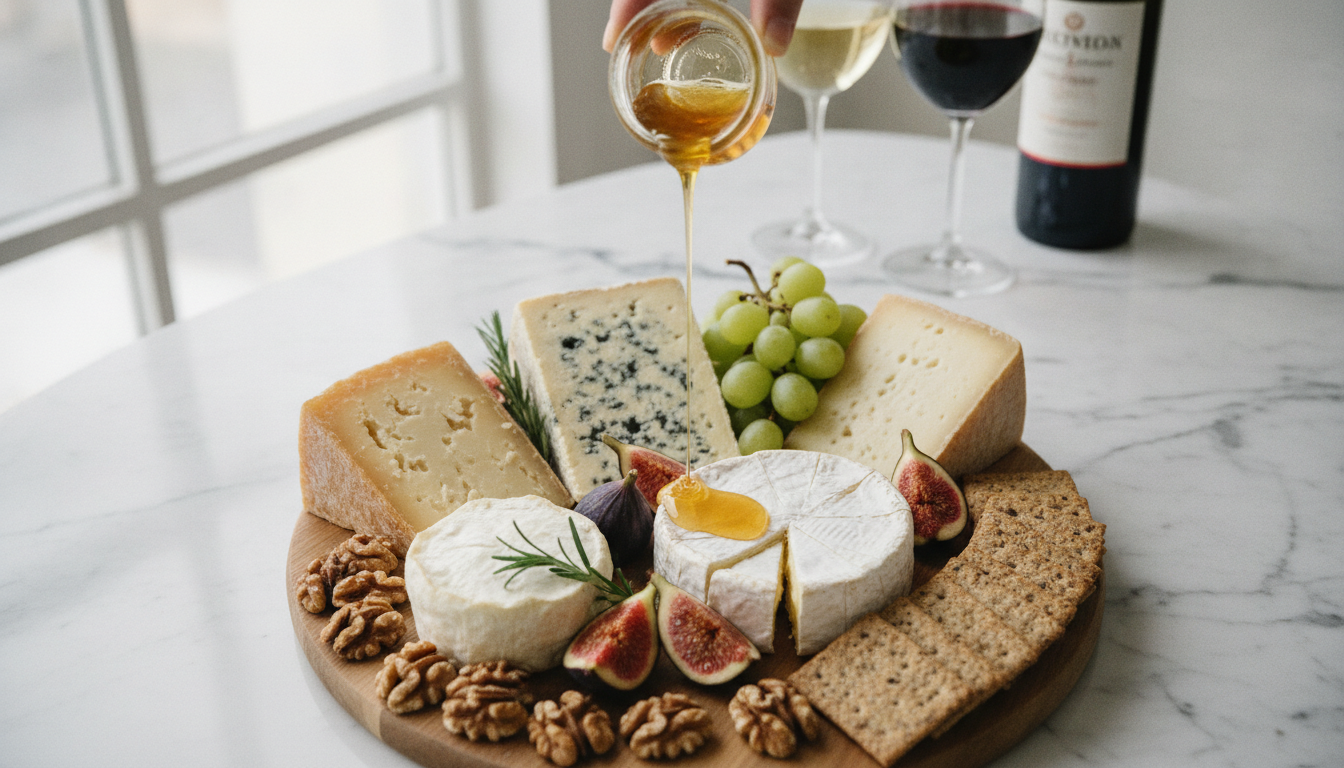
Cheese pairing in fine dining goes beyond the cheese itself. The accompaniments on the board are just as carefully thought out as the cheese selection. Honey, jams, nuts and fruit aren't decoration but functional flavor partners that amplify or contrast certain aromas.
Sweet Companions and Their Function
Honey with salty cheese is one of the oldest and most popular combinations. Acacia honey goes wonderfully with mild goat cheeses, while strong chestnut honey underlines the spicy notes of an aged Pecorino. Fig jam works especially well with blue cheese, since the sweetness balances the salty sharpness of Roquefort.
For nuts, the rule is: walnuts go with soft cheeses like Brie or Camembert, almonds suit Spanish hard cheeses and hazelnuts complement alpine mountain cheeses perfectly. These pairings are often based on regional tradition, since cheese and nuts from the same areas naturally go together.
Bread and Crackers: The Right Foundation
In cheese pairing, bread is more than just a carrier. Neutral white bread or unsalted crackers let the cheese flavor come through unadulterated. Walnut bread intensifies creamy cheeses, while rye bread goes with strong mountain cheeses. In upscale restaurants, toasted brioche is often served, whose light buttery note underlines the texture of the cheese without dominating.
How Do I Pair Cheese with Wine Correctly
Combining cheese and wine is a science of its own. The old rule that red wine goes with cheese is too sweeping. In fact, many types of cheese pair better with white wine, since the tannins in red wine can develop metallic flavor notes with the fat in cheese.
A dry white wine like Sauvignon Blanc or a light Riesling goes with fresh cheese and young goat cheeses. The acidity in the wine cuts through the creaminess of the cheese and refreshes the palate. With semi-firm cheeses like Gouda or Comté, both full-bodied white wines like Chardonnay and fruity red wines like Pinot Noir work.
Strong red wines are recommended with aged hard cheese. An old Parmigiano Reggiano can handle a Barolo or Amarone, while a Spanish Manchego harmonizes perfectly with a Rioja. Blue cheese is an exception: here sweet wines like Sauternes or port are the classic choice, since their sweetness balances the salty sharpness.
According to a 2012 University of California, Davis study, the majority of test subjects rate cheese and wine combinations as more harmonious when wine and cheese have similar flavor intensities. A subtle cheese with a subtle wine, a strong cheese with a full-bodied wine.
Which Types of Cheese Go with Which Drinks
Besides wine, there are other drinks that play a role in cheese pairing in fine dining. Craft beer is experiencing a renaissance as a cheese companion. A Belgian tripel goes excellently with soft cheese, while a dark stout complements blue cheese. The carbonation in beer cleanses the palate between courses.
Champagne and sparkling wines are versatile companions. Their acidity and fizz work with most types of cheese, especially creamy varieties like Brie de Meaux. A brut Champagne brings out the buttery notes of a ripe Camembert without overpowering it.
Tea is increasingly offered as an alternative in upscale restaurants. Green tea goes with fresh cheese, black Assam with spicy hard cheeses and oolong with medium-aged semi-firm cheeses. These combinations originally come from Asian fusion cuisine but have found their way into European fine dining concepts.
Restaurant Etiquette: Dos and Don'ts with Cheese
At upscale meals, there are unwritten rules that underline your culinary knowledge. Always cut cheese in the shape in which it was served. With a wedge, you start at the tip and work toward the rind; with round slices, you cut pie-shaped pieces. That way the shape is preserved for the guests who follow.
The rind is generally edible, except on paraffin-coated cheeses or very hard wax. With soft cheese like Camembert, the rind is part of the flavor experience. With hard cheese like aged Gouda, it's often too hard and is set aside. When in doubt, watch your date or ask discreetly.
Always try all the cheeses offered, even if there are some you may not know. That shows openness and interest in new flavor experiences. At upscale tastings, it's common to take notes or ask the staff questions. That doesn't come across as know-it-all but as engaged.
Culinary Knowledge: Recognizing and Placing Regional Cheeses
Different regions have their own cheese traditions, which are reflected in flavor and texture. French cheese from Normandy like Camembert or Pont-l'Évêque is typically creamy and mild, while cheese from the Alps like Beaufort or Gruyère is firm and nutty. Knowing these regional differences enriches any conversation during the meal.
Swiss cheeses like Emmentaler or Appenzeller have characteristic holes created by propionic acid bacteria during aging. Italian cheeses like Parmigiano Reggiano or Grana Padano are aged for at least 12 months and develop crystalline textures. Spanish Manchego made from sheep's milk has a unmistakably firm texture with sweetish notes.
This knowledge allows you, in cheese pairing in fine dining, to recognize the origin and spark fitting conversation topics. If you identify a Roquefort, for example, and mention that it may only come from the Aveyron region, that shows genuine appreciation for food culture.
How Do I Come Across as Competent at Fine Dining: Subtle Signals
Competence at upscale meals shows not through displayed knowledge but through calm confidence. When the cheese board is served, wait a moment and watch how it's presented. Often the staff explains the selection, and here you can show your interest with targeted follow-up questions.
Ask questions like "Which region does this blue cheese come from?" or "How long was the hard cheese aged?" instead of claiming to know everything. Real connoisseurs are curious, not all-knowing. This attitude makes you more likable and approachable during the meal instead of seeming distant.
Avoid turning down cheese or pulling faces. Even if you don't like one kind, try it politely and then move on to another. At upscale meetings, it's about the shared experience, not personal preferences that have to be announced loudly.
Temperature Makes the Difference

An often overlooked aspect of cheese pairing is serving temperature. Cheese should never be served straight from the refrigerator, since cold suppresses the aromas. The optimal temperature is between 59 and 68 degrees Fahrenheit (15 to 20 degrees Celsius). In good restaurants, cheese is taken out of refrigeration about 30 minutes before service.
With soft cheese like Brie, the creamy consistency fully unfolds at room temperature. Hard cheese only develops its nutty notes with sufficient warmth. If you prepare a cheese board at home, plan for this time. It shows care and considerably raises the quality of the flavor experience.
What Do I Need to Know About Cheese Pairing: The Essence
Cheese pairing in fine dining isn't a performance but an opportunity to experience enjoyment consciously. The most important points are the order from mild to intense, an understanding of regional specialties and the right combination with drinks and accompaniments. If you internalize these basics, you navigate any upscale cheese selection with confidence.
The art lies in letting your knowledge flow in naturally without sounding preachy. A casual comment like "I love the combination of blue cheese with figs" opens conversations, while a lecture on Roquefort production methods does the opposite. Balance is everything.
Trust your senses. Even without expert knowledge, you can tell what you like and why. This authenticity is more valuable when dining together than book-learned expertise that isn't backed by real experience. Try, enjoy and be open to new things.
Practical Tips for Your Next Upscale Dinner
Mentally prepare for the fact that not every cheese will suit your taste. That's perfectly fine. Use the opportunity to broaden your palate and discover new worlds of flavor. Make notes during or after the meal about cheeses you especially liked.
If you're unsure which wine goes with which cheese, ask the sommelier. That shows interest and lets you learn from real experts. Most sommeliers gladly share their knowledge and appreciate guests who are interested in the subject. This interaction can even lead to interesting conversations that go beyond the culinary aspect.
Document your experiences. A quick photo of the cheese board or a note on your smartphone helps you remember special combinations later. That way you build your own repertoire over time that steadily expands your culinary competence. You can use this knowledge at future upscale meetings.
FAQ: Common Questions About Cheese Pairing in Fine Dining
Which types of cheese should I try on my first fine dining experience?
Start with classic, accessible varieties like Brie, Comté and a mild blue cheese like Gorgonzola Dolce. These three cheeses cover different flavor profiles without being too extreme and let you explore your preferences.
How much cheese should I try at an upscale dinner?
Take a small piece of each kind, about one to two bites per cheese. That's enough to get the flavor without filling you up or affecting the rest of the meal.
Is it rude not to eat the cheese rind?
No, with hard rinds or wax coatings it's customary to set them aside. With soft cheese, however, the rind is part of the enjoyment and should be eaten.
What do I do if I don't recognize a cheese on the board?
Ask the staff for details about its origin and flavor. This curiosity is seen as interest rather than ignorance and shows your willingness to learn.
Which drinks go best with a mixed cheese board?
Champagne or a dry white wine like Chablis are versatile companions that go with most types of cheese. Alternatively, a light red wine like Pinot Noir also works.
Conclusion: Cheese Pairing as Cultural Competence
Cheese pairing in fine dining is more than culinary knowledge; it's a form of cultural education that creates real added value at upscale meetings. From the right order to fitting flavor combinations to confident restaurant etiquette, these details show your appreciation for food culture. Understanding types of cheese, their regional origin and their harmonious pairing with wine or other drinks not only broadens your culinary horizon but also makes you a more interesting conversation partner.
Use your next upscale dinner to put this knowledge into practice. Taste consciously, ask questions and enjoy the variety on offer. That way every meeting becomes an opportunity to develop your culinary competence while staying authentic. Cheese pairing in fine dining isn't an exam but an invitation to learn with pleasure.